
In the vast digital tapestries woven by game developers, a silent dance unfolds between freedom and constraint. Since the pixelated corridors of side-scrollers, where invisible barriers whispered 'turn back,' the challenge has been to craft worlds that feel boundless yet remain beautifully contained. As landscapes have swelled into sprawling continents and oceanic depths, the methods of gentle persuasion have evolved from blunt denial to narrative poetry and playful terror. In 2026, the legacy of these creative constraints endures, reminding us that the most memorable borders are not walls, but stories.
7. Motocross Madness 2: The Comedic Catapult
In an era before hyper-realism, creativity reigned supreme. Motocross Madness 2 offered expansive desert and woodland courses that teased the horizon. The temptation to explore beyond the checkered flags was immense. Yet, those who ventured too far were met not with a jarring stop, but with a spectacle of pure, chaotic fun. An invisible boundary would launch rider and bike skyward in a spectacular, physics-defying arc back onto the track.
 -Cropped-5.jpg?q=50&fit=crop&w=825&dpr=1.5)
The accompanying whistle as they cannonballed earthward transformed a moment of limitation into one of shared laughter. It was a lesson delivered not with a scold, but with a mischievous wink—a reminder that some boundaries exist purely for our amusement.
6. Sea of Thieves: A Pirate's Haunting Dream
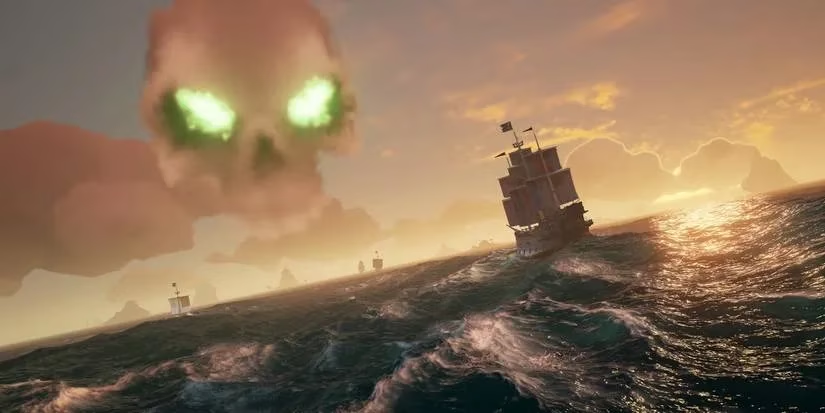
Few games weave their boundaries into their very soul like Sea of Thieves. The call of the open sea is a siren song for every pirate, but the game answers with a descent into maritime myth. As a ship sails beyond the known world, the environment itself begins to protest.
The sky bleeds crimson, the water churns with unnatural hues, and an ominous score swells. The ship groans, takes on water, and eventually succumbs. Should a player persist, the world fades to black, only for them to awaken on a familiar shore, the entire harrowing journey feeling like a fever dream lost to the depths. This method doesn't just stop the player; it tells a ghost story.
5. Subnautica: The Abyss Gazes Back
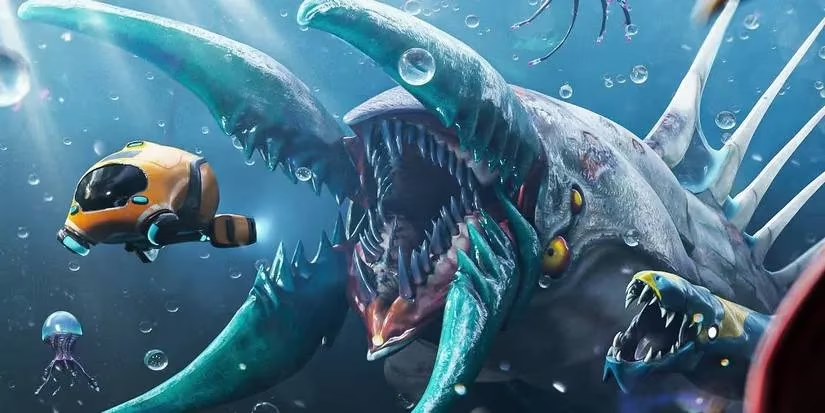
The deep blue of Subnautica is a canvas of wonder and primal fear. Its boundaries are enforced not by code, but by consequence, masterfully playing on the player's own curiosity and dread. Venturing into the void prompts desperate warnings from the onboard AI: "Are you certain whatever you're doing is worth it?"
Ignoring these pleas summons the guardians of the deep. The ethereal, serpentine Ghost Leviathan emerges from the darkness—a breathtaking and terrifying embodiment of the game's central theme: respect the unknown. Its swift attack is a definitive, ecological answer to transgression, reinforcing that some frontiers are meant to remain mysteries.
4. Minecraft: The Quiet Frontier
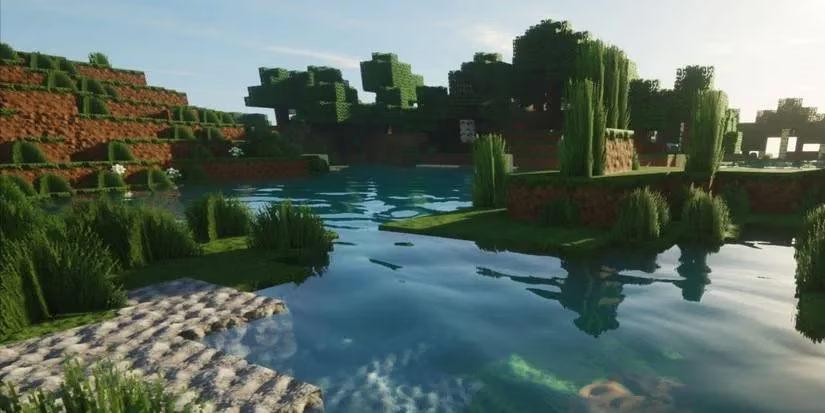
Minecraft's world feels infinite, a testament to procedural generation. Yet, even its seemingly endless blocks have an end. The journey to the "Far Lands," though largely smoothed in modern iterations, remains a legendary pilgrimage. Reaching this archaic edge presents a paradox.
The world continues visually, stretching into a garbled, geometric dreamscape, but progress is halted by a translucent, silent wall. It is a humbling, almost philosophical barrier. It doesn't scream or attack; it simply states, through quiet impossibility, that here, the simulation ends. The only choice is to turn back, carrying the knowledge of the map's true, silent shape.
3. Grand Theft Auto V: The Mechanical Betrayal
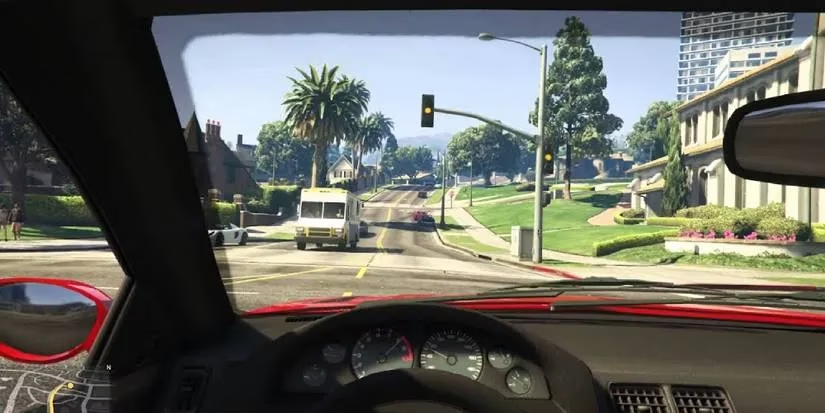
Los Santos is a sun-drenched prison of its own making, and Rockstar's method for containment is one of cold, mechanical realism. The vast ocean surrounding the island is the ultimate barrier. Whether by stolen jet or speedboat, the escape attempt feels thrillingly possible.
The betrayal is sudden. Engines sputter and die with finality, leaving players adrift in the silent expanse. Then, the circling fins appear. The game corrals the player not just with a dead engine, but with the threat of a predator-infested sea, turning a simple boundary into a fight for survival against the environment itself. It's a stark reminder of nature's dominion.
2. Splashdown: The Tentacle of Discipline
The PS2 era's Splashdown captured the joy of high-speed jet-skiing across vibrant waterways. Its courses, marked by buoys, were invitations for aquatic stunts. But straying from the path invoked a punishment drawn from nautical legend.
-Cropped-8.jpg?q=50&fit=crop&w=825&dpr=1.5)
Without warning, the calm surface would rupture. A colossal squid tentacle, a pixelated Kraken, would rise and slam down upon the hapless racer. This sudden, almost cartoonish act of divine retribution was unforgettable. For a generation of players, it taught a visceral lesson: the open water hides ancient rules, and some race tracks are fenced by myth.
1. Spore: The Circle of (Digital) Life
Spore is a journey of evolution, from tide pool microbe to galactic civilization. Its early stages are intimate; your creature is your child. The oceanic phase, however, introduces a brutal, natural law. Venturing too far from the safe, sunlit shallows triggers a change.
.jpg?q=50&fit=crop&w=825&dpr=1.5)
The music dips into a sinister register. From the inky darkness below, a gaping maw—a creature of pure, predatory id—ascends and consumes your creation in one bite. The emotional impact is profound. This isn't a game-over screen; it's an ecological correction. The boundary is enforced by the food chain itself, a raw, Darwinian reminder that in nature, curiosity can indeed be fatal. It remains one of gaming's most effective and poignant containment methods.
These games, from the slapstick to the sublime, demonstrate that a world's edge need not be a dead end. It can be a punchline, a ghost story, a philosophical statement, or a natural law. The most creative barriers don't break immersion; they deepen it, transforming a technical limitation into a memorable moment within the world's own logic. They remind the player that every universe, no matter how open, has its own rules, myths, and monsters guarding the final frontier.