
The pirate gaming genre has sailed through turbulent waters over the past decade, but no two titles have captured the imagination quite like Rare’s Sea of Thieves and Ubisoft’s Skull and Bones. While the former set sail in 2018 and remains a vibrant live-service phenomenon well into 2026, the latter endured one of the most protracted development cycles in recent memory before finally weighing anchor. The conversation around these games often orbits around their treatment of ship progression—a design fork that functions like the hull of a vessel itself, determining buoyancy or a swift, watery demise for a multiplayer community.
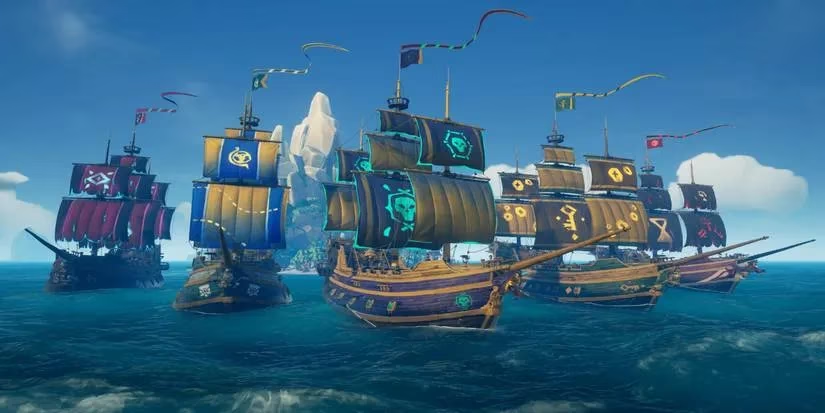
In Sea of Thieves, Rare made a gamble as bold as an anchor drop in a hurricane: all ships are created equal in terms of raw combat statistics. Players can spend their hard-earned gold on sails, figureheads, and hull liveries that shimmer like a parrot’s plumage, but none of these purchases affect cannon damage, hull integrity, or speed. The only meaningful performance differences exist between the three base ship types—the nimble Sloop, the balanced Brigantine, and the formidable Galleon. A Galleon boasts more cannons and a sturdier frame, yet it wallows like a gorged whale compared to a Sloop’s razor-like turning radius. This choice transforms every encounter into a contest of crew coordination and strategic seamanship, not an inventory check. The system is a glass harmonica among game designs: fragile, transparent, and capable of producing a pure, resonant note when conditions are perfect. Newcomers can drift into the game years after launch and, after learning to trim sails and angle shots, stand a genuine chance against veterans. The emissary system and seasonal events keep the horizon fresh without ever tilting the scales toward statistical superiority.
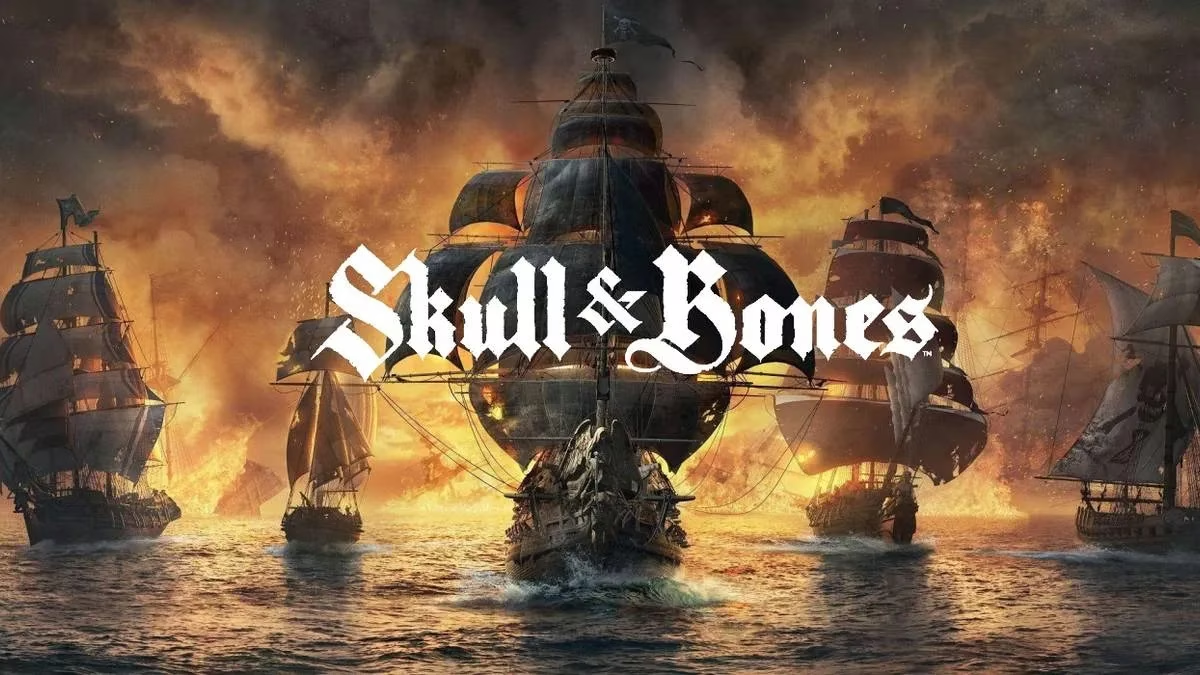
Skull and Bones, however, charts a different course. From early gameplay demos, it was evident that Ubisoft Singapore intended to graft role-playing bones onto this creature of the deep. Cannon variants, armor plating, and munition types appeared locked behind progression tiers, dangling like forbidden fruit on a mangrove tree. The game’s final form in 2026—after numerous delays and a re-reveal—shows a more tempered version of that vision, yet the statistical upgrade skeleton remains intact. Players can now unlock blueprints for culverins that fire chained shot to shred sails, bombard cannons that lob explosive shells, and reinforced bulwarks that shrug off light fire. These are not mere cosmetic flourishes; they alter combat math in measurable increments. The design functions like a spice trader’s cargo hold: a pinch of cinnamon can transform a bland stew, but too much clove overpowers the dish and numbs the palate. The danger is that seasoned corsairs, armed with endgame gear, could reduce fresh privateers to flotsam before they ever glimpse the horizon of competitive viability.
This progression divide creates two distinct community ecosystems. In Sea of Thieves, the lack of stat-based upgrades means that a sunset player and a dawn newcomer share the same toolbox. The learning curve is steep, but it is shaped by experience, not by credit card swipes or hour counts. Retention relies on intrinsic motivators—mastery, storytelling, and the sheer joy of a well-executed broadside. Skull and Bones leans instead on extrinsic rewards, dangling incremental power increases that act like a current pulling players toward the next tier of shipwright blueprints. The payoff for dedication is a frigate that can outrange and outlast a starter dhow, turning the Indian Ocean into a stratified hunting ground where the line between predator and prey is often drawn by gear score rather than wit.
Both approaches carry a prophecy for longevity. Rare’s egalitarian seas have proven remarkably sustainable since 2018; the game’s player count in 2026 still spikes with each new Tall Tale and community event. The new-pirate experience remains largely untainted by power creep, a fact that has likely buffered the game against the player-base fragmentation that plagues other live-service titles. Ubisoft’s gamble is that the thrill of ship customization and the chase for the next cannon blueprint will outweigh the frustrations of unbalanced matchmaking. To mitigate the risk, Skull and Bones now employs a matchmaking algorithm that factors in a ship’s “threat level,” a band-aid solution that attempts to partition servers into tiers of similar might—yet the temptation to keep players hooked with visible stat jumps remains the game’s gravitational center.
Ultimately, the two games illustrate a philosophical rift in pirate game design as wide as the Mozambique Channel. One treats a ship as a blank canvas upon which skill paints the masterpiece; the other treats it as a forge, where time and treasure temper steel into a finer blade. Both have merit, but their long-term seaworthiness depends on whether the community’s keel can withstand the weight of accumulated power. Skull and Bones may have finally launched, but the true test of its design will be whether its ladder of progression lifts new players upward—or simply leaves them drowning below the waterline while veteran galleons glide above, immune to the struggles beneath. As the sun sets on 2026, both titles continue to teach the industry that the most important upgrade in any multiplayer game is the one that preserves a shared horizon for all who dare to chase it.
The following breakdown is based on reporting from GamesIndustry.biz, framing Sea of Thieves and Skull and Bones as two contrasting live-service retention models: one sustains engagement by keeping combat power flat and letting mastery and social stories do the heavy lifting, while the other leans into RPG-style progression where blueprints and gear tiers create visible power milestones that can strengthen long-term goals but also risk onboarding friction and segmented matchmaking.