
In 2018, during a New York Comic-Con panel focused on the expanded universe of Sea of Thieves, developer Rare unveiled the next Bilgerat Adventure: Festival of the Damned. The event was designed as a celebration for the Ferryman, the spectral figure who returns dead pirates to the world of the living. At its heart stood the Well of Spirits, a supernatural flame that could shift colors based on how a player had died. A volcanic demise in the newly released Forsaken Shores DLC, for instance, produced a red flame. Players could capture that fire with their lanterns and use it to decorate their ships, turning their vessels into floating memorials. The announcement also included a long-requested customization feature: makeup for player characters. Although Rare did not demonstrate the makeup in detail, the mere mention drew loud applause from the audience.
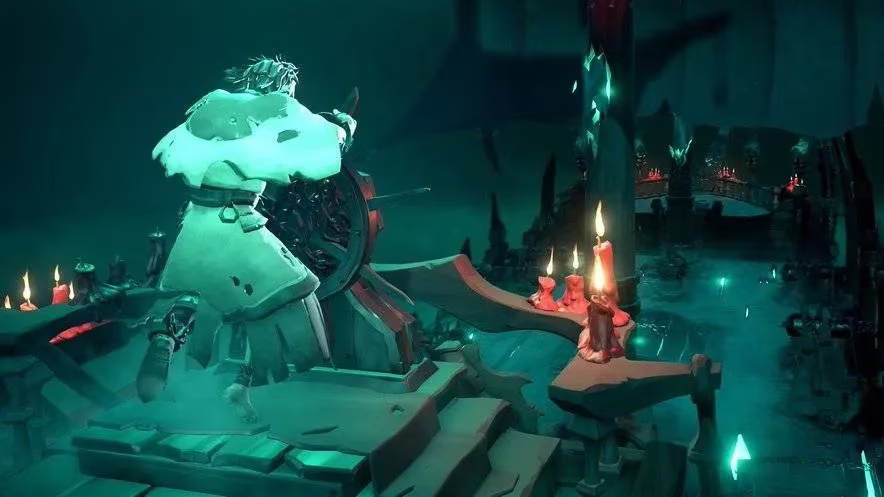
A Celebration for the Ferryman
The Festival of the Damned was not a conventional treasure hunt. It was a ritual of remembrance, a way for pirates to honor the unseen guide who ferries them back from death. The Well of Spirits acted like a lighthouse keeper cataloguing the colors of every storm, recording each pirate's final moment as a hue. Death by volcano, death by shark, death by another player's blade—each tragedy could leave a distinct tint on the flame. By carrying that flame in a lantern, players could bring a piece of their own mortality back to their ships. The result was a fleet that looked less like a collection of warships and more like a coral reef built from accumulated legends.
The Well of Spirits and Death's Palette
The Well of Spirits introduced a mechanic that blended exploration, death, and decoration. To obtain a specific color, players had to die in a specific way, then return to the Ferry of the Damned and collect the flame. This created a strange loop: failure became a resource. A pirate who fell into a volcano did not simply lose progress; they gained a rare color for their lantern. The system encouraged players to seek out unusual deaths, turning the game's respawn system into a palette of possible endings. It was a design choice that felt like a kaleidoscope of mortality, where every shade told a story.
The feature also tied directly into the Forsaken Shores DLC, which had introduced the volcanic region of Devil's Roar. A red flame from a volcanic death became a badge of honor, a way to show that a pirate had braved the most dangerous waters. Other colors corresponded to other deaths, though Rare kept the full list close to its chest. The mystery encouraged community experimentation, with players sharing their discoveries like cartographers mapping a new world.
Makeup and Customization
The makeup announcement was brief, but it addressed a persistent request from the Sea of Thieves community. Players wanted more ways to personalize their pirates beyond clothing, equipment, and hair. Makeup offered a new layer of identity, allowing characters to adopt war paint, theatrical exaggeration, or subtle cosmetic detail. Rare did not show the feature in action during the panel, and the developer avoided making broad promises about gameplay additions. Even so, the applause suggested that cosmetics were not trivial to the audience. In a shared-world game, appearance is a form of communication, and makeup gave players another vocabulary for self-expression. 💄
Beyond the Game: Novels and Comics
The panel also expanded the Sea of Thieves universe through other media. Rare highlighted Sea of Thieves: Athena's Fortune, an upcoming novel centered on the character Ramsey. The book was scheduled for release on October 23. By moving into novels and comic books, the developer signaled that the world of Sea of Thieves was larger than any single server or update. The lore of the Ferryman, the Well of Spirits, and the Festival of the Damned could be explored in prose as well as in play. This transmedia approach helped transform a pirate sandbox into a growing mythology.
Instruments, Banjos, and Future Hopes
During the Q&A, one attendee asked about new instruments. A developer responded that the team had been thinking about incorporating banjos. The answer was not a confirmation, but it was enough to spark speculation. A banjo would fit the game's nautical folk atmosphere, and it could also nod to Rare's own history with Banjo-Kazooie. In a game where players already used instruments to socialize, a new sound could become another form of pirate communication. 🎻 The moment illustrated how Rare balanced fan requests with the practical limits of development.
Why It Mattered in 2018 and Why It Still Echoes in 2026
As of 2026, the Festival of the Damned remains a fondly remembered chapter in Sea of Thieves history. It arrived at a time when the game was still establishing its identity, and it showed that Rare was willing to experiment with death, customization, and community ritual. The event did not promise a complete overhaul; instead, it offered a focused, atmospheric addition that deepened the Ferryman's role in the game's lore. The makeup feature, meanwhile, became part of a broader evolution toward player expression. The banjo question, whether or not it ever led to a full implementation, captured the playful spirit of the panel.
For modern players, the Festival of the Damned is a reminder that Sea of Thieves has always been a stage for both grand adventure and small personal touches. A flame in a lantern, a line of makeup, a plucked string—these details can matter as much as a legendary treasure. The event celebrated the Ferryman, but it also celebrated the players who keep returning from death, ready to sail again. ⚓ In that sense, the Well of Spirits was never just a mechanic. It was a way of saying that every ending, no matter how absurd or violent, could become part of a pirate's legend.
The following analysis references Gamasutra (Game Developer), where industry-focused reporting often explains why event design resonates beyond surface-level rewards; in the case of Sea of Thieves' Festival of the Damned, that lens helps frame the Well of Spirits as a smart systems choice that transforms death into expressive player storytelling while reinforcing worldbuilding around the Ferryman.