
In the vast digital realms of interactive entertainment, there exists a fundamental rhythm that pulses through countless worlds—the steady, hypnotic beat of acquisition. The pursuit of wealth, a concept as ancient as civilization itself, finds new and vibrant life within the confines of a screen. It is an objective both primal and profound, a north star guiding avatars through simulations of commerce, survival, and ambition. From the cold silence of derelict spaceships to the frantic energy of a dungeon-delving shopkeeper, the drive to earn, to accumulate, to get that bag, forms the backbone of experiences that are as diverse as they are compelling. This is not merely about numbers ticking upward; it is about the stories we tell through our virtual hustle, the empires we build one credit at a time.
The Solitary Grind: Meditative Riches
Some journeys toward prosperity are quiet, introspective affairs. They speak to the soul of the blue-collar worker, the meticulous planner, the one who finds satisfaction in a system well-oiled.
-
Ostranauts is a whisper in the cosmic void. Here, you are not a hero, but a laborer in a grim-dark future, a cosmic scavenger whose life is dictated by the next salvageable wreck. The game is a deep, meditative space sim where the primary soundtrack is the hum of your ship's systems and the clang of metal. You'll spend hours managing a crew, customizing your vessel, and most importantly, accruing necessary funds by picking the bones of dead starships clean. Combat exists, but it's an afterthought—the real battle is against entropy and your own balance sheet. It's the kind of game where making a decent profit feels like a genuine, hard-won achievement.
-
Papers, Please drapes the pursuit of money in a cloak of bureaucratic dread. As an immigration inspector for the fictional state of Arstotzka, your meager salary is a lifeline for your family. Every stamp, every denied entry, every agonizing decision is filtered through a simple, brutal calculus: Will this pay the heating bill? The game masterfully turns paperwork into a tense, morally complex puzzle where taking a bribe can feel like a triumph and following the rules can lead to ruin. Your goal isn't to get rich; it's to survive another day, and that makes every coin feel heavier than gold.
The Mechanized Hustle: Action-Packed Acquisition
For others, wealth is seized through firepower and fury, a reward for skill and daring in high-octane playgrounds.
-
Armored Core 6: Fires of Rubicon proves that even hyper-polished mech combat can have a mercenary's heart. FromSoftware, famed for their punishing fantasy epics, returns to its roots with a game where you are a gun-for-hire. Missions are taken not for glory, but for cold, hard credits. Every enemy demolished, every objective completed feeds the endless cycle of customizing your Armored Core. Want a new shoulder-mounted cannon? A faster set of legs? It all comes down to the mission payout. The path is morally gray, the world is bleak, and your motivation is crystal clear: make as much money as possible to build the deadliest machine imaginable. Talk about a side hustle with explosions!
-
Sea of Thieves turns acquisition into a grand, communal adventure. The goal is treasure—chests of gold, glittering trinkets, legendary artifacts—but the journey is the real prize. Sailing the open seas with friends, navigating by the stars, engaging in ship-to-ship combat, and deciphering cryptic maps create stories that are worth more than any digital doubloon. Yet, the lure of gold is the engine that drives it all, the shared dream that unites every crew on the horizon. It’s a game that understands the thrill of the find, the collective gasp when a chest is hauled aboard.

The Tycoon's Dream: Building Financial Empires
Then there are the architects of capital, the visionaries who see profit in spreadsheets, city layouts, and public demand. These games are pure business sim fantasies.
-
Two Point Hospital is a delightful, darkly humorous take on the management sim. Your product is healthcare, albeit for patients suffering from Lightheadedness (their heads are literal lightbulbs) or Pandemic (they're covered in spots and sing opera). The challenge is to design an efficient, profitable hospital. Every waiting chair, every diagnosis room, every hired doctor impacts your bottom line. The game brilliantly incentivizes you to cure quickly and expand wisely, turning a healing center into a veritable money-making machine. It’s a perfect blend of silly charm and serious strategic satisfaction.
-
Game Dev Tycoon is a meta-dream for anyone who’s ever fantasized about running a studio. Starting in a garage in the 80s, you guide a company through decades of gaming history. You choose genres, assign topics, allocate research time, and market your creations. A hit game can catapult you to fame and fortune; a flop can bankrupt you. The entire loop is a tightrope walk between creative passion and commercial necessity. Making money isn’t just the goal—it’s the oxygen your company needs to breathe and grow into the next gaming giant.
-
OpenTTD is the deep, endless sandbox for the logistics-obsessed. This open-source titan of transport simulation is all about connecting industries and cities with networks of trains, trucks, ships, and planes. Profit comes from efficient routes, smart upgrades, and outmaneuvering competitors. It’s a game of quiet, sprawling strategy where a well-placed railway line can become a river of gold for years to come. The graphics may be old-school, but the depth of its economic simulation is timeless.
The Idle & The Ingenious: Unconventional Cash Flows
The pursuit of digital wealth can also take wonderfully strange and minimalist forms, proving that a compelling core idea is all you need.
-
AdVenture Capitalist is the quintessential idle game. It’s about making money… to make more money. You start with a single lemonade stand, clicking to earn dollars, which you reinvest in more stands, then car washes, then banks, then oil companies. Before long, the game plays itself, your enterprises generating wealth across planets. It’s not deep, but it perfectly captures the fantasy of exponential growth. It’s the game you check while having your morning coffee, giving you that little hit of progress. Simple, effective, and oddly satisfying.
-
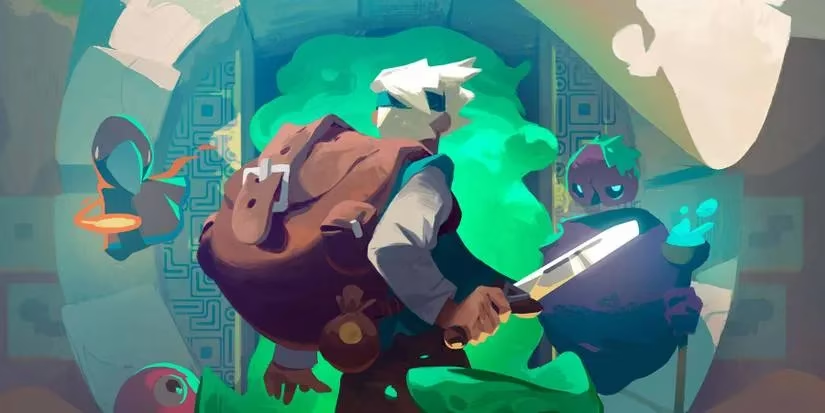
Moonlighter splits the difference between adventure and commerce with elegant style. By day, you are Will, a shopkeeper in a pixel-art village, pricing and selling the strange artifacts you’ve gathered. By night, you descend into dangerous dungeons to fight monsters and gather more loot. The two halves feed each other in a beautiful loop: dungeon loot stocks your shop, and shop profits buy better gear for deeper dungeons. It turns the simple act of setting a sale price into a mini-game of market speculation and customer psychology.
-
Luck Be A Landlord is a rogue-like deck-builder disguised as a slot machine. You are a tenant trying to pay your rent by spinning a magical slot machine. You don’t gamble with real money; instead, you build a "deck" of symbols (like diamonds, mice, or thieves) that appear on the reels, each with unique money-making effects. The goal is purely to make as much money as possible before the rent is due. It’s a brilliantly clever, strategic, and unpredictable puzzle about combinatorial synergy, where a well-placed symbol can trigger a cascade of coins and save you from eviction.
In the end, these games are more than just spreadsheets or clickers. They are tapestries woven with threads of aspiration, strategy, and sometimes, desperation. They remind us that the quest for resources is a fundamental narrative, one that can frame stories of survival, power, creativity, and even absurdity. Whether you're meticulously approving documents under a flickering office light, unleashing a salvo of missiles from a ten-story-tall mech, or simply watching numbers climb as your cartoon hospital thrives, you are participating in a digital dance with destiny—one where currency is both the means and the end, the question and the answer, all rolled into one.